How to answer enterprise security questionnaires
By SealSec · July 30, 2026
The first enterprise security questionnaire is a rite of passage for a SaaS team. A promising deal is moving, and then procurement sends a spreadsheet with three hundred rows about encryption, access control, incident response and data residency. The founder loses a week to it, the answers are half guesses, and three months later the next prospect sends a slightly different spreadsheet and the week repeats.
The fix is not answering faster. It is answering once.
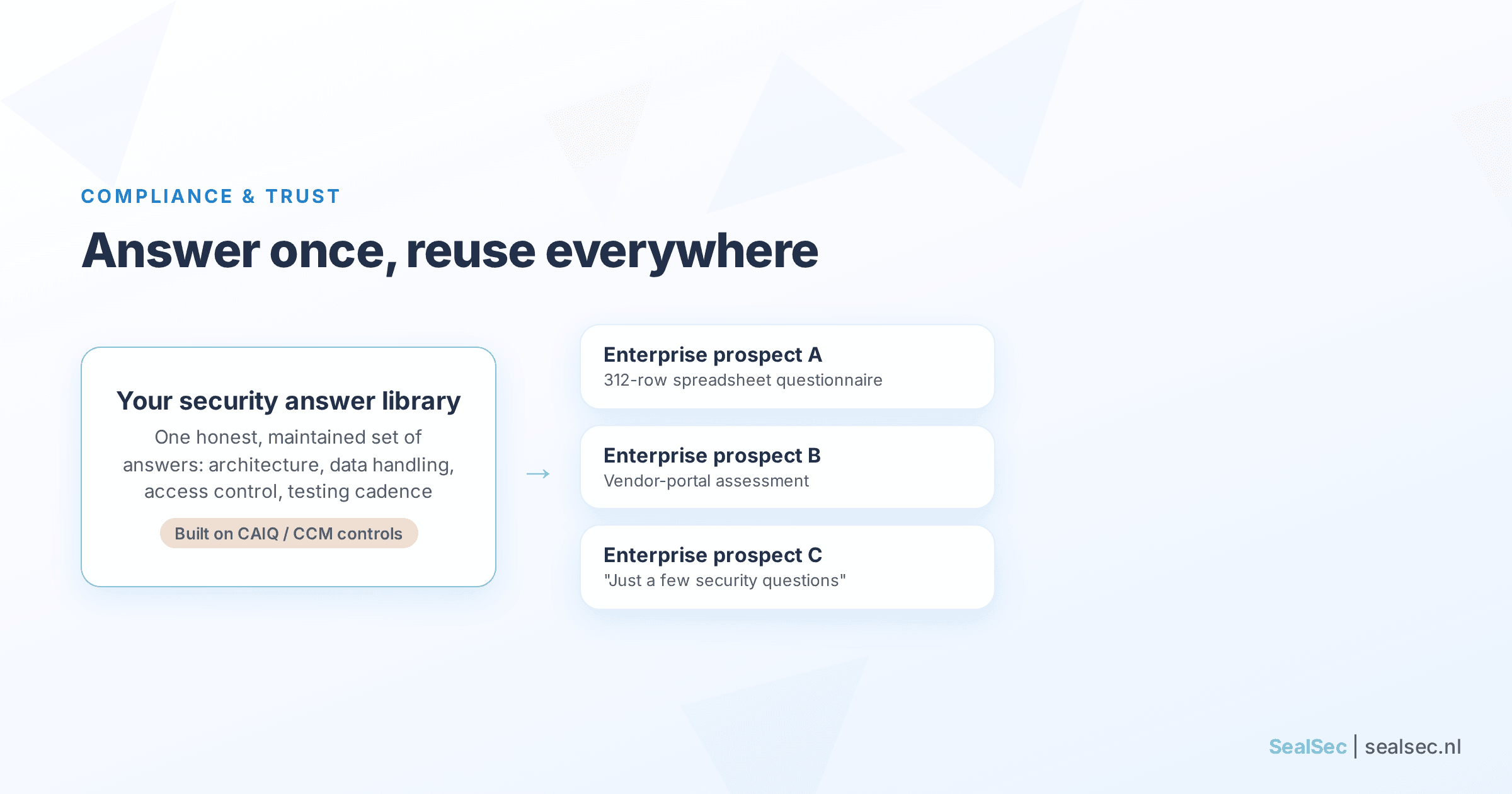
Build an answer library, not an answer
Treat the first questionnaire as the occasion to write down your real security posture in one maintained document: how the product is architected, how customer data is stored and encrypted, who can access production, how you test, how you would handle an incident. Every future questionnaire becomes a mapping exercise against this library instead of a writing project.
You do not have to invent the structure. The Cloud Security Alliance's Cloud Controls Matrix (CCM) is a cloud security control framework with 197 control objectives across 17 domains, and its companion CAIQ questionnaire is the standardized yes/no version many buyers accept directly. Organizing your library along those domains means your answers already speak procurement's language.
Be honest about gaps, with a date
Nothing sinks trust in a questionnaire like a "yes" that a follow-up call reveals to be a "sort of." Enterprise security reviewers read hedged answers all day; a clear "not yet, planned for Q4" with a short rationale reads as maturity, not weakness. The library makes this easier: gaps get tracked in one place, and every closed gap upgrades all future answers at once.
Attach evidence that does the arguing for you
Three attachments answer more rows than any prose:
A recent penetration test summary, with the findings fixed and retested. This single document collapses most of the "do you test your security?" section.
Your architecture and tenant isolation note, because how you keep customers apart is the question behind many of the data-protection rows.
Your coordinated vulnerability disclosure policy, which shows you handle the unexpected in a defined way.
Keep the library alive
An answer library goes stale the same way documentation does. Tie its review to events you already have: after every pentest, after every architecture change, after every incident. Ten minutes of upkeep per event keeps every future questionnaire a half-day job.
The pattern behind all of this is the same one that runs through good security work generally: do the real thing once, write it down, and let the artifact answer for you.