How to prepare your SaaS for its first pentest
By SealSec · July 30, 2026
Most SaaS teams book their first penetration test for one of three reasons: an enterprise prospect asked for a recent report, ISO 27001 or a similar framework requires periodic testing, or a big release is about to ship and someone finally said "we should get this looked at." Whatever the trigger, the difference between a useful pentest and an expensive PDF is mostly decided before the test starts.
Here is what to have ready.
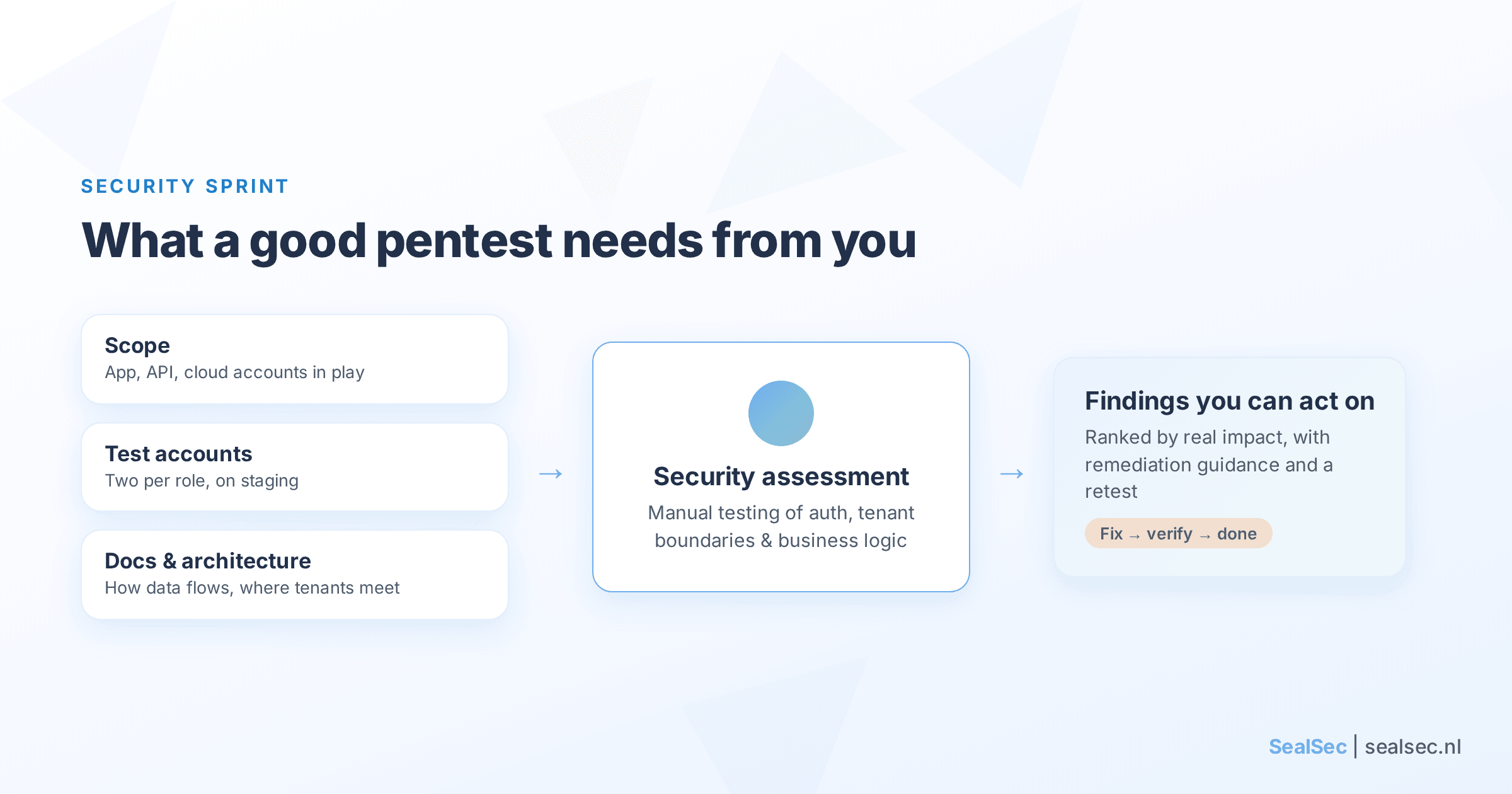
Decide what is actually in scope
"Test our app" is not a scope. List the things that hold or touch customer data: the web application, the public API, mobile apps if you have them, the cloud accounts they run in, and anything internet-facing that you forgot about, which is usually the most interesting part for an attacker. If you run a multi-tenant product, say so explicitly: tenant isolation should be named in the scope, because cross-tenant access is the highest-impact class of finding in SaaS.
A smaller, honest scope beats a broad vague one. Testers spend their hours where you point them.
Set up test accounts before day one
Good testing is done logged in. Provide at least two accounts per role (two admins, two regular users, two tenants), so the tester can check both vertical access (can a user do admin things?) and horizontal access (can tenant A read tenant B?). Put them on a staging environment that matches production closely. Every day a tester waits for credentials is a day of testing you paid for and did not get.
Share how the system actually works
A short architecture note beats a wiki dump: how requests flow, where authentication happens, how tenants are separated, which parts are legacy. Testers work from a methodology, most commonly the OWASP Web Security Testing Guide, a framework of testing scenarios maintained by security professionals worldwide. The methodology covers the ground; your context tells the tester where the bodies are likely buried.
Know what "good" looks like in the report
A useful report ranks findings by real-world impact on your product, not by scanner severity, and every finding comes with enough reproduction detail that your engineers can fix it without guessing. Expect a remediation conversation, not just a document. And insist on a retest: a finding is closed when someone has verified the fix, not when the ticket is moved to done.
After the test
Two cheap follow-ups make the next test better and the current one more valuable:
Publish a coordinated vulnerability disclosure policy, so researchers who find issues between tests have a safe way to reach you.
Keep the report summary handy for sales. A recent pentest with fixed findings is one of the strongest answers you can give on a security questionnaire.
A first pentest always finds something. That is the point. The teams that get the most out of it are the ones that treat it as the start of a fix-and-verify loop rather than a certificate to frame.